 Arizona Photoshoot
Antelope Canyon Photography Rules: What You Can and Cannot Shoot
Antelope Canyon photography rules changed in 2019 in a way that still surprises visitors planning a trip today: tripods, monopods, selfie sticks and every other camera support are banned in every public section of the canyon, handheld only. That single rule reshaped the whole photography-tour industry at Antelope Canyon, and it sits alongside entry fees, drone bans, and restrictions on staged sessions that every visitor, guided or independent, needs to know before booking.
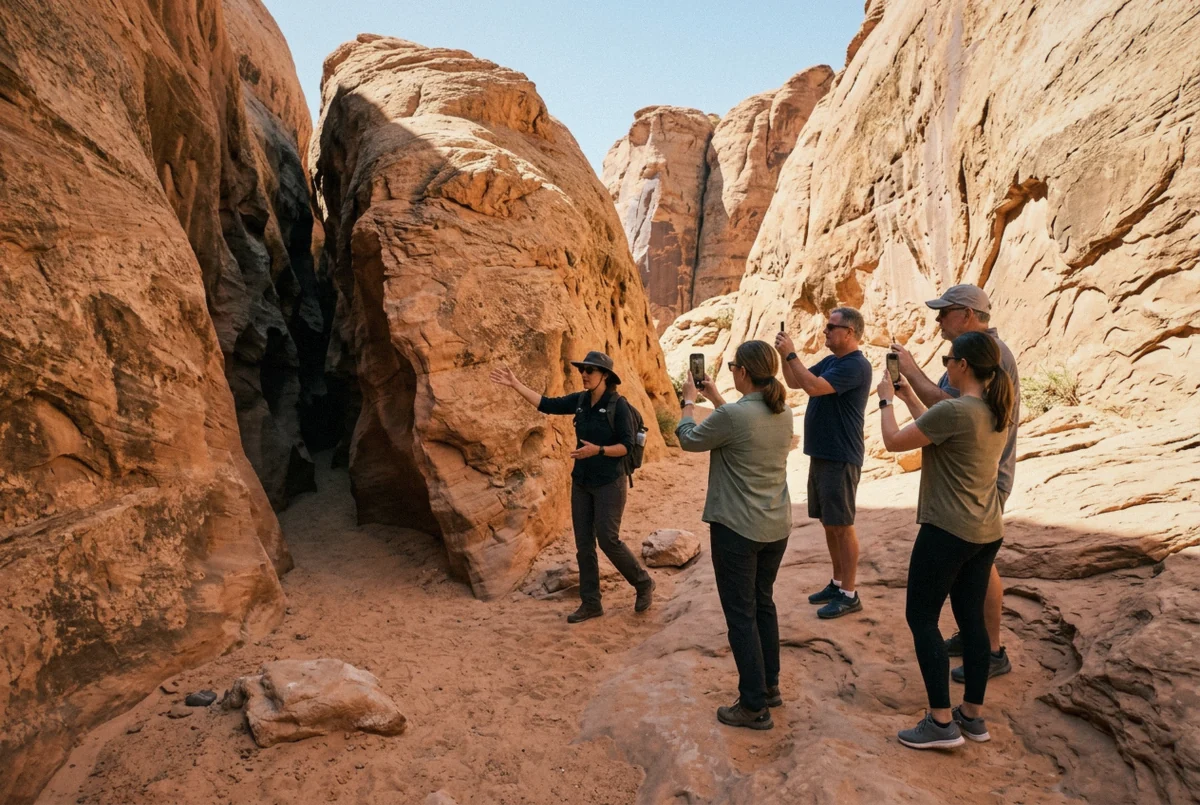
Quick answer Tripod ban, entry fees, drones, and staged shoots
Yes, you are allowed to take pictures in Antelope Canyon, but since 2019 tripods, monopods, selfie sticks and all other camera-support equipment are banned in every public section, handheld phone or camera only. Entry requires an authorized Navajo guided tour, bundled with a $15 per person, per day permit fee, and drones, staged wedding-style shoots, and dedicated photo tours of Upper Antelope have all been discontinued or restricted since the rule change.
Key takeaways
- Tripods, monopods, and selfie sticks have been banned in all public sections since 2019; handheld shooting only, enforced by your Navajo-authorized guide.
- Entry only happens through a guided tour; the Lower Canyon runs about $80.50 per person all-in, including the Navajo permit. See the full fee breakdown.
- Drones are banned on Navajo Nation land and in every US national park, no exceptions for a quick aerial shot.
- Formal or staged shoots, including wedding dresses, need prior arrangement with Navajo Nation Parks & Recreation and a commercial photography permit; a standard sightseeing tour does not cover this.
- See Antelope Canyon photoshoot sessions on the comparison page that already work inside these rules rather than around them.
- Weather closes the canyon fast and without warning; a 1997 flash flood is the reason operators don't gamble on marginal conditions.
The Tripod Ban, Since 2019
The single biggest change to Antelope Canyon photography rules landed in 2019, when the Navajo Nation Parks and Recreation Department, working with the canyon's tour operators, banned tripods, monopods, selfie sticks and any other camera-support equipment across every publicly toured section of the canyon. The rule applies equally to Upper and Lower Antelope Canyon, and it is enforced on the spot by whichever Navajo-authorized guide is leading your group; there is no separate permit or exception process for a tourist who brought a tripod from home.
The same 2019 change effectively ended dedicated photography tours of Upper Antelope Canyon. Before the ban, operators sold longer, slower-paced tours specifically built around tripod photography, timed to the midday light-beam window. Those tours were discontinued once support equipment was banned, since the whole format depended on set-up time a handheld-only tour doesn't need. Standard sightseeing tours still run through Upper Antelope on the same schedule as before, and handheld shooting, phone or camera, remains fully allowed on every one of them.
Entry Fees and How the Navajo Permit Works
You cannot enter either Upper or Lower Antelope Canyon on your own. Entry is only possible through an authorized Navajo guided tour, booked with one of the licensed operators such as Ken's Tours or Dixie Ellis's, and the price you pay bundles a $15 per person, per day Navajo Nation permit fee into the ticket rather than charging it separately at a gate. Lower Antelope Canyon runs about $80.50 per person all-in once that permit and the guide fee are combined.
This is a different fee entirely from a park entrance fee at somewhere like the Grand Canyon; there's no vehicle fee to think about, since you're not driving into the canyon yourself; the tour operator handles the whole visit from a fixed meeting point in Page, Arizona.
Antelope Canyon Entry at a Glance
| Item | Cost | Notes |
|---|---|---|
| Lower Antelope Canyon guided tour | about $80.50 per person, all-in | Includes the $15 per person, per day Navajo permit; Ken's Tours, Dixie Ellis's and similar operators |
| Navajo Nation permit | $15 per person, per day | Bundled into every guided tour's ticket price, never billed separately |
| Independent entry | Not available | No self-guided or walk-up access exists at either canyon |
Bags, Pets, and What Else Is Prohibited
Backpacks, purses, and other large bags are prohibited on Antelope Canyon tours; guides ask visitors to leave them in the vehicle before entering the slot canyon, both for the narrow passageways and to keep the group moving through on schedule. Pets and service animals are not allowed inside the canyon on any tour, guided or otherwise, since the terrain includes tight ladders and narrow rock corridors that aren't safe for an animal to navigate.
Drones are banned outright on Navajo Nation land, a rule that sits on top of the separate, nationwide ban on recreational drone flights in all US national parks that has been in effect since 2014. Between the two, there is no legal path to fly a drone over or inside Antelope Canyon regardless of which agency's land you're technically standing on at the time.
Staged and Formal Photography: What Needs Special Arrangement
A standard guided tour ticket covers handheld photography of yourself and your group as you move through the canyon with everyone else in the tour. It does not cover a formal, staged photo shoot, wedding dress or otherwise, and any commercial photography, meaning photos taken for paid client work rather than personal memories, requires a separate Navajo Nation commercial photography permit arranged in advance with Navajo Nation Parks & Recreation.
This is exactly the gap the catalog's bookable sessions are built to close. The Antelope Canyon land shoot pairs a private photography session with a separately ticketed Navajo guided tour, so the photographer and the canyon-entry permit are two different bookings working together rather than one covering the other; the Antelope Canyon boat tour sidesteps the land-side rules entirely by reaching the flooded arm of the canyon from Lake Powell, where you shoot your own photos from a small boat rather than walking the slot canyon on foot. Neither package promises a staged, dressed-up photo shoot inside the canyon itself; anyone planning that kind of session needs to arrange it directly with Navajo Nation Parks & Recreation well ahead of a visit. If a flowing dress in the frame is the goal, an Arizona flying dress session shoots that look at Horseshoe Bend and other open rim locations instead, where the same staged-shoot restriction that applies inside Antelope Canyon does not.
Upper or Lower Canyon: Which Is Better for Photography?
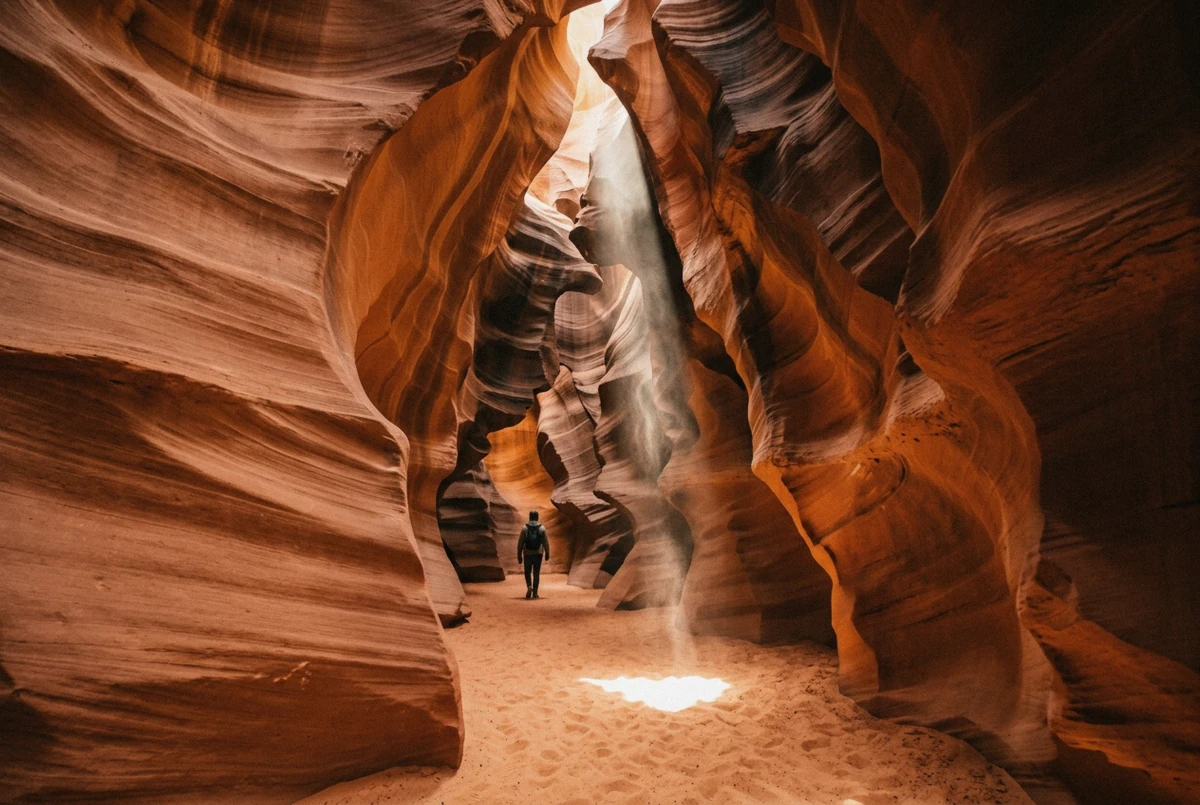
Upper Antelope Canyon is the more famous of the two for photography, mainly because of its light beams, direct shafts of sunlight that reach the canyon floor during a roughly late-March-to-early-October window, typically visible in the late morning to midday hours when the sun sits high enough overhead. Upper Antelope is entered at ground level, which makes it the more comfortable option for anyone who'd rather avoid ladders.
Lower Antelope Canyon involves several steel ladder staircases to descend into and climb back out of the slot, which some visitors find physically harder, but its walls carve a more twisting, layered shape that many photographers find more visually interesting shot for shot than the wider Upper chambers. Both canyons fall under the same 2019 tripod ban and the same entry-fee structure; neither offers an advantage on rules, only on the visual style of what you'll come away with.
Weather Closures and Why They Happen Fast
Antelope Canyon closes on flash-flood risk, sometimes with very little warning, because a slot canyon this narrow gives water almost nowhere to go once a storm hits anywhere upstream in its watershed. That policy exists because of a real, documented tragedy: in 1997, a flash flood swept through Lower Antelope Canyon and killed 11 hikers who had entered on a clear day while a storm was building miles away. Every guided operator since has treated marginal weather as a reason to cancel rather than proceed, and a canyon closure for flash-flood risk is not something to argue with a guide about at the meeting point.
The practical upshot for a photography trip: build a buffer day into your Page, Arizona itinerary if the shot matters to you, since a tour rescheduled or refunded for weather is far better than one that runs when it shouldn't.
Shooting Handheld: What Changes Without a Tripod
Losing a tripod matters most in low light, and the canyon interior sits well below what most cameras and phones are used to metering for even at midday. A higher ISO than you'd normally choose is the direct trade-off; grain in a canyon photo reads as texture more than it reads as a flaw, so pushing ISO 800 to 3200 on a dedicated camera, or letting a phone's night mode handle the same job automatically, recovers most of what a tripod's longer exposure would have bought.
Bracing against a canyon wall, on the rare stretch wide enough to do it without blocking the group behind you, steadies a handheld shot nearly as well as a monopod would. A wide-angle lens or a phone's standard lens also forgives handheld shake better than a zoomed-in telephoto shot of the same wall, since any small movement is proportionally smaller in the frame.
The guides themselves are a resource most visitors skip past. A guide who works the same 200 meters of rock daily knows which exact spot produces the shot everyone's phone is aimed at, and will point it out unprompted on most tours; asking directly, rather than waiting to be told, gets more of that knowledge out of a rushed group tour than staying quiet does.
Which Rule Applies to You?
If you're bringing a tripod or monopod for the light beams
leave it in the car; handheld only, enforced by your guide, in every public section since 2019
If you want to fly a drone for an aerial shot
don't; banned on Navajo Nation land and in every US national park
If you're planning a wedding-dress or other staged shoot inside the canyon
arrange it in advance with Navajo Nation Parks & Recreation; a standard tour ticket doesn't cover it
If you booked the Antelope Canyon land shoot or boat tour
you're covered; both packages work within these rules rather than needing a separate permit from you
If the forecast looks marginal on your tour date
expect a possible last-minute closure for flash-flood risk, and build a buffer day if the shot matters
Upper vs Lower Antelope for Photography
Same rulebook, different frames
Both sections sit on Navajo land, share the tripod ban and the $15 permit, and close on the same flash-flood warnings. What changes is the shooting itself, and the split decides which ticket suits your camera. Every bookable option sits on the Arizona photoshoot comparison homepage.
| Upper Antelope | Lower Antelope | |
|---|---|---|
| Light beams | Late morning to midday, roughly late March to early October | Rare, canyon is narrower and brighter |
| Terrain | Flat sandy floor, walk-through | Ladders and stairs, one-way loop |
| Crowds | Heaviest, timed entries | Somewhat lighter, same timed system |
| Ticket | Higher priced tours | About $80.50 per person all-in |
| Best for | Beam shots, mobility-limited visitors | Sculpted walls, fewer shoulders in frame |
Antelope Canyon Photography Rules: Common Questions
Are you allowed to take pictures in Antelope Canyon?
Yes, handheld photography with a phone or camera is fully allowed in both Upper and Lower Antelope Canyon on every guided tour. What's banned is camera-support equipment: tripods, monopods, and selfie sticks, since 2019.
Is Upper or Lower Antelope Canyon better for photography?
Upper Antelope is known for its midday light beams, visible roughly late March through early October; Lower Antelope has a more twisting, layered wall shape but requires descending steel ladders. Both fall under the same tripod ban and entry-fee rules.
Can I bring a tripod into Antelope Canyon?
No. Tripods, monopods, and selfie sticks have been banned in all public sections since 2019, enforced by your Navajo-authorized guide on the spot.
Are backpacks allowed in Antelope Canyon?
No. Backpacks, purses, and other large bags are prohibited on tours; guides ask visitors to leave them behind before entering the canyon.
Can you visit Antelope Canyon without a guided tour?
No. Independent, self-guided entry is not available at either canyon; every visitor enters through an authorized Navajo tour operator, with the $15 per person, per day permit bundled into the ticket.
Are drones allowed at Antelope Canyon?
No. Drones are banned on Navajo Nation land, on top of the separate nationwide ban on recreational drones in all US national parks.
Do I need a special permit for a staged or wedding photo shoot in Antelope Canyon?
Yes. A standard tour ticket only covers handheld personal photography. A staged or wedding-style shoot needs prior arrangement with Navajo Nation Parks & Recreation, and any commercial photography needs a separate Navajo Nation commercial permit.
Why does Antelope Canyon close so suddenly for weather?
Because a slot canyon this narrow can flood fast from a storm building miles away. A 1997 flash flood killed 11 hikers in Lower Antelope Canyon, and every operator since treats flash-flood risk as an immediate reason to cancel a tour rather than proceed.
Sources
This page is checked against primary Navajo Nation sources and licensed tour operators. See Navajo Nation Parks & Recreation for permit and land-use rules, and Navajo Tours for operator-published tour rules on tripods, bags, pets, and drones.
None of these rules make Antelope Canyon harder to photograph well; they make it a handheld, guided experience rather than a tripod-and-timer one, and every bookable session on this catalog already works inside them.